Wabi-sabi art is a Japanese aesthetic and artistic philosophy rooted in Zen Buddhism that centers on the acceptance of transience and imperfection. Rather than striving for perfection, symmetry, and permanence, wabi-sabi finds beauty, authenticity, and elegance in things that are imperfect, impermanent, and incomplete, inspired by nature itself.
Here are some principles of Wabi-Sabi:
Impermanence: Recognizing that all things are in a constant state of flux, aging, decaying, or wearing down, and that this cycle is natural and beautiful.
Asymmetry and Irregularity: Rejecting strict geometric symmetry in favor of organic shapes, accidental brushstrokes, and natural asymmetry.
Simplicity: Stripping away the unnecessary to reveal the pure essence of a material or object without clutter or pretense.
The Beauty of Age: Honoring the marks of time, such as patina on bronze, weathered wood grain, fading colors, or cracks.
In the art practice and process there are a few characteristics that stand out:
Embracing Flaws: In wabi-sabi ceramics, artists often celebrate warping, uneven glazes, rough textures, or asymmetries that happen naturally during the firing process. In wood art, the flaws come with the wood (knots, colors) and the previous use (cracks, nail holes, discoloration) becoming a beautiful element of the artwork.
Kintsugi (Golden Joinery): Perhaps the most famous application of this philosophy. When a ceramic bowl breaks, it is not thrown away. Instead, it is meticulously repaired with lacquer dusted or mixed with powdered gold, silver, or platinum. The fractures become glowing highlights, making the repaired object more beautiful for having been broken. Similar to this process, I have been using discarded wood pieces and use glue to laminate those pieces into larger wood blocks. When applying linseed oil these glue lines turn darker and highlight the fragmentation of the piece.
Natural Materials: Wabi-sabi art heavily favors unpretentious, organic materials that age gracefully over time—such as clay, raw wood, unpolished stone, rusted iron, linen, and handmade paper. In my work with reclaimed redwood, I am always amazed how aging made the wood even more beautiful. Some of the wood I am using was installed as roof rafters, wall studs, or fence boards for up to 100 years.
Here is a piece that is made from aged, reclaimed redwood, has an irregular shape (wood pieces and grain), embraces flaws of the wood and uses joinery (laminated wood pieces). It is called “Slice of Summer”.
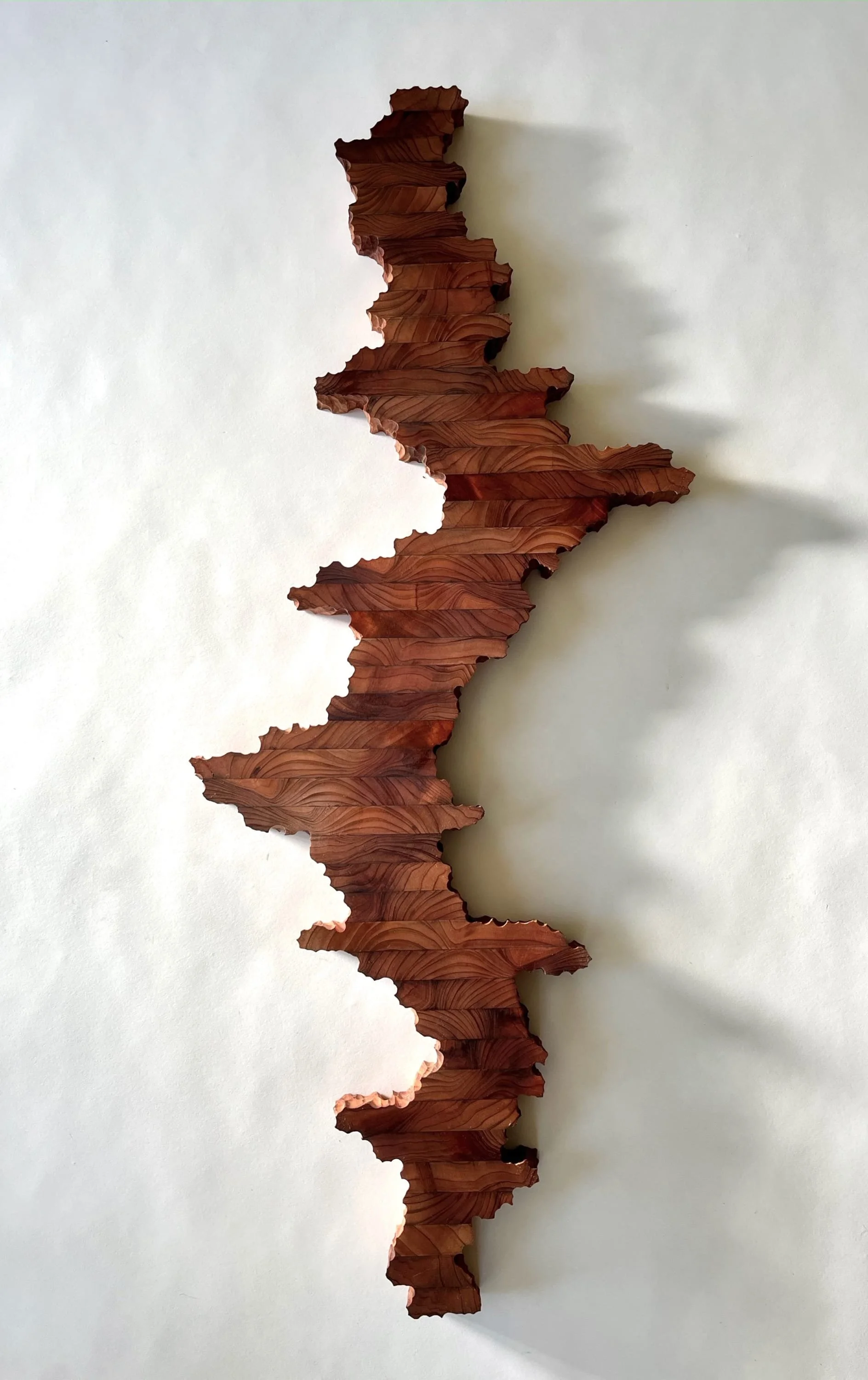
Wabi-sabi wood sculpture: Slice of Summer